How to Choose a Hot Tub Dealer You Can Trust
A trustworthy hot tub dealer does more than sell you a spa. They influence your delivered price, installation plan, warranty experience, repair timeline, and total ownership cost for years after the sale.
That matters because a hot tub is a wired, water-filled system, not a simple patio accessory. A great model can become a frustrating purchase if the dealer is vague about delivery, slow on warranty service, or unwilling to put promises in writing. On the other hand, a competent local dealer can make a mid-range tub feel like a smart long-term investment.
If you are comparing dealer-sold brands in 2026, choose the dealer with the same discipline you use to choose the tub. The right approach is not about finding the friendliest salesperson. It is about verifying service capability, quote transparency, warranty execution, and fit for your home.
The short answer: trust the dealer who documents everything
A reliable hot tub dealer should be able to explain the full ownership path before you leave a deposit: what is included, what is excluded, who services the spa, what happens if something breaks, what your site needs, and how final pricing is calculated.
Use this quick trust test before getting deep into model comparisons.
| What to verify | A trustworthy dealer can show | Caution sign |
|---|---|---|
| Authorization | Proof they are an authorized seller for the brand, when applicable | “We can get any brand” without documentation |
| Service support | In-house service team or a clearly named service partner | “Just call the manufacturer” after delivery |
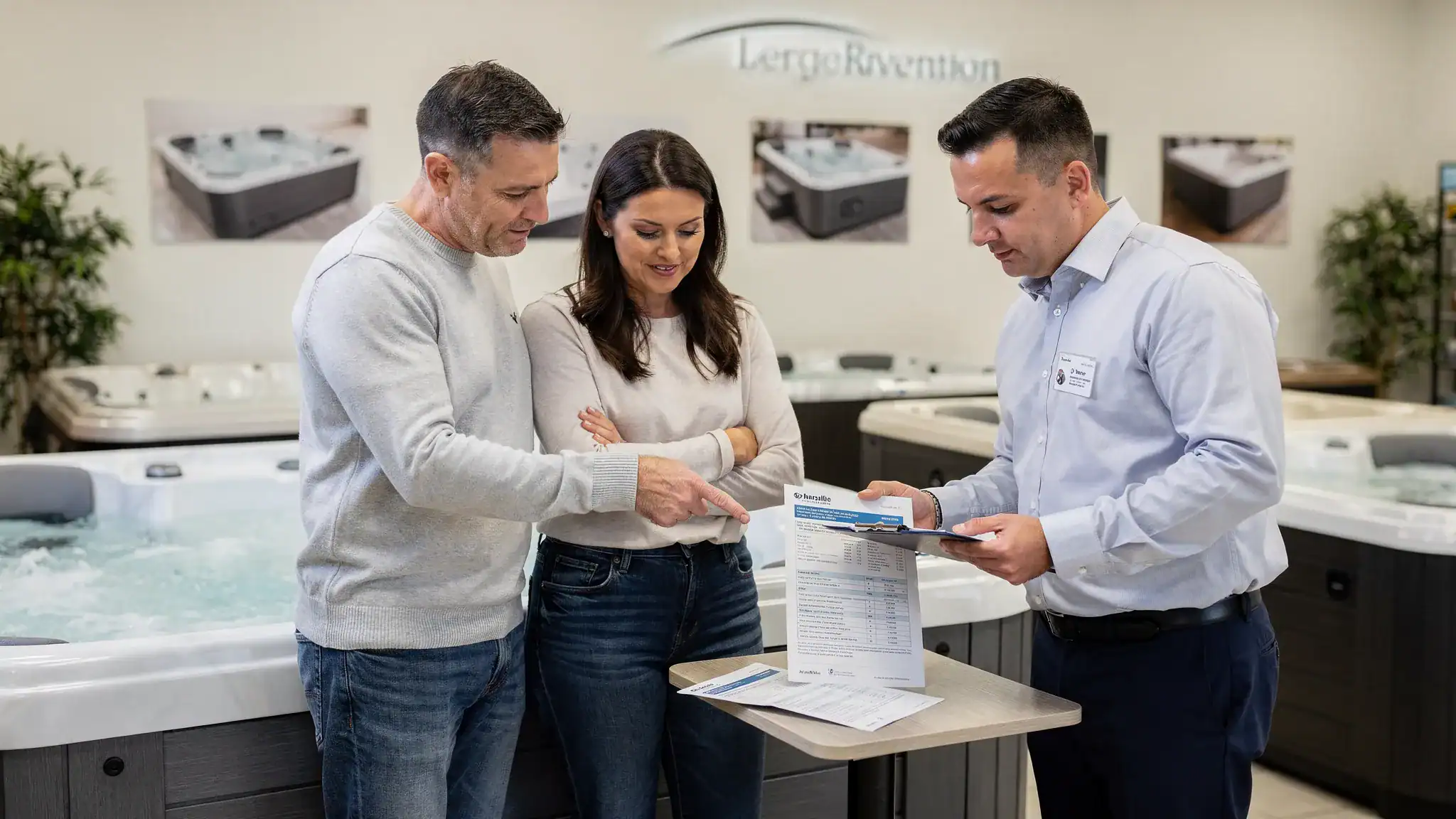
| Quote transparency | Itemized out-the-door quote with model, options, delivery, tax, and extras | One lump-sum price with verbal promises |
| Warranty process | Written warranty terms and explanation of trip, labor, and diagnostic fees | “Everything is covered” with no details |
| Installation plan | Clear electrical, pad, access, and delivery requirements | “It should be fine” without measuring |
| Reputation | Consistent local reviews and reasonable complaint handling | Many unresolved service complaints |
The pattern is simple: good dealers reduce uncertainty. Risky dealers create urgency.
Why the dealer matters as much as the hot tub brand
Many premium and upper-mid hot tubs are sold through regional dealer networks. That means the manufacturer builds the product, but the local dealer often handles the quote, delivery coordination, startup guidance, first-line service, and warranty communication.
This is why two people can buy the same model and have very different ownership experiences. One buyer gets a clean delivery, fast support, and honest advice about chemicals and maintenance. Another buyer gets surprise fees, delays, unclear warranty coverage, and weeks of waiting for a basic repair.
At Hot Tub Value Guide, dealer support is one of the practical value signals we consider when evaluating ownership outcomes. Hardware matters, but so does the network behind it. If you want to understand how we think about long-term hot tub value, review our public scoring methodology.
Start with three dealers, not one showroom
The biggest mistake shoppers make is walking into one showroom, falling in love with one model, and letting that dealer define the entire buying process. A better approach is to shortlist at least two or three local options before you negotiate.
Look at each dealer’s website, brand lines, review history, service area, showroom location, and years in business. Then compare the patterns in owner feedback. A few negative reviews are normal in any service business. The key is whether complaints cluster around the same issues, such as missed service appointments, poor warranty follow-through, delivery damage, or pressure tactics.
You can also check business profiles on the Better Business Bureau and local consumer review platforms. Do not treat any single rating as absolute truth. Instead, look for consistency across multiple sources.
Verify they are authorized and able to service what they sell
For dealer-channel brands, authorization matters. An authorized dealer is more likely to have access to current models, warranty registration, parts, brand training, and manufacturer support. If a dealer is selling a brand but cannot clearly confirm their relationship with the manufacturer, slow down.
Ask whether they service the exact brands they sell. Some dealers have in-house technicians. Others use subcontractors. Either model can work, but the dealer should be direct about who will come to your home, how service calls are scheduled, and what fees apply outside warranty coverage.
This is especially important if the spa uses proprietary components, specialized controls, or brand-specific accessories. A low purchase price loses much of its appeal if routine parts are hard to source or if every repair requires a long wait.
Demand an itemized out-the-door quote
A trustworthy hot tub dealer should give you a written quote that makes the final price easy to understand. This is not just about negotiating. It is about avoiding surprise costs after you have already committed.
The quote should identify the exact model, year or current series, shell and cabinet color, jet package, cover, steps, cover lifter, starter chemicals, delivery method, taxes, and any site-specific charges. If financing is involved, ask for the cash price and financed price separately so you can compare the real cost.
| Quote line item | Why it matters | What to ask |
|---|---|---|
| Exact model and configuration | Similar model names can hide different specs or trim levels | “Can you list the full model name and included options?” |
| Cover and cover lifter | These affect energy use and everyday convenience | “Is the cover included, and what cover lifter is quoted?” |
| Delivery | Backyard placement may cost more than curbside delivery | “Does this include placement on my pad?” |
| Crane or special access | Tight yards, decks, and slopes can add major cost | “What happens if the delivery crew cannot access the site?” |
| Electrical work | Usually handled by a licensed electrician, not the spa dealer | “What wiring is required, and what is not included?” |
| Taxes, permits, and fees | These can change the true out-the-door price | “Is this the final price I pay before electrical?” |
| Accessories and water care | Bundles vary widely by dealer | “Which items are included and which are optional?” |
If a dealer refuses to itemize, that is a useful signal. Clear quotes protect both sides.
Ask how warranty support works in real life
The printed manufacturer warranty is only part of the story. You also need to understand how the local dealer handles warranty claims.
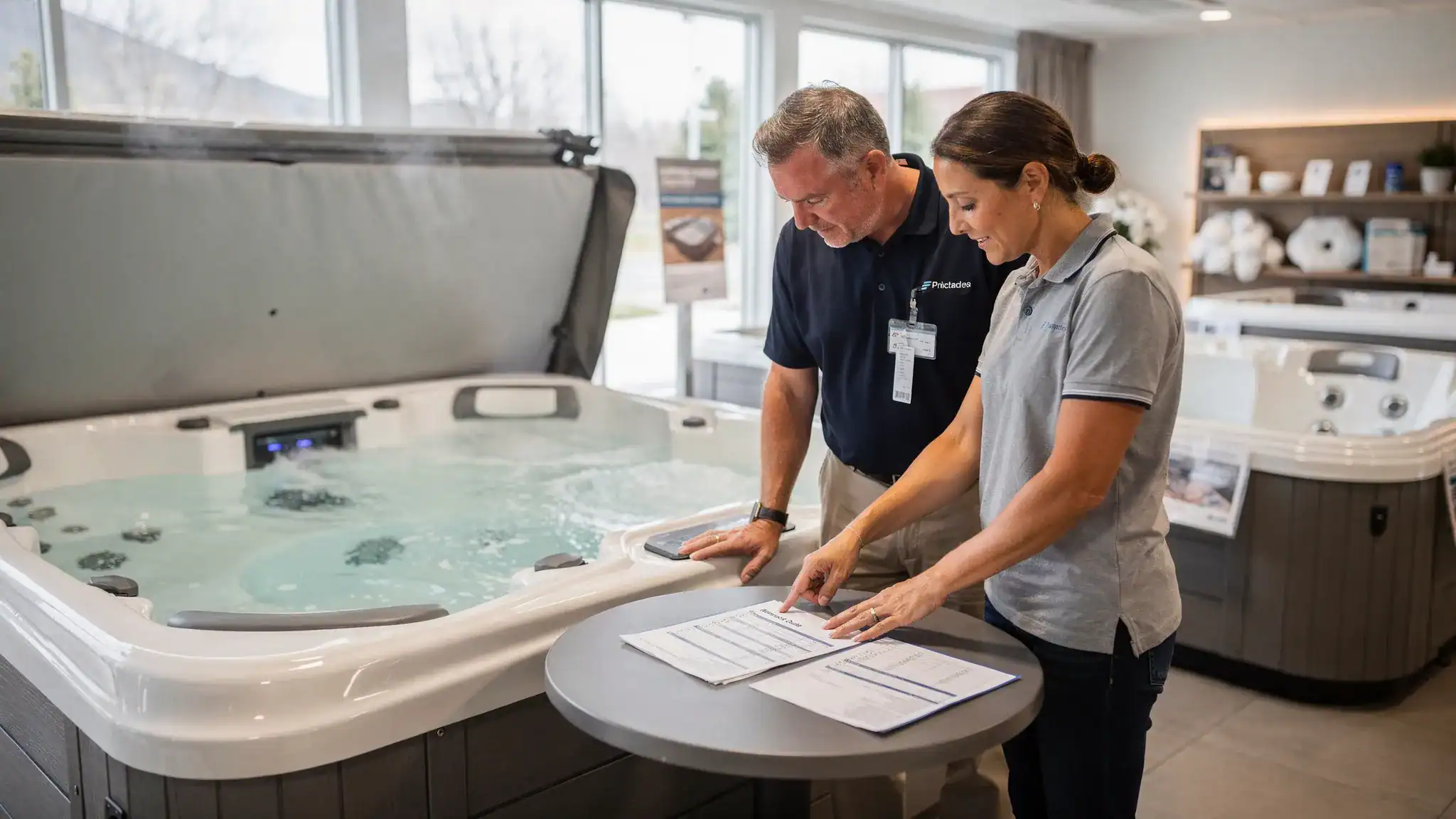
Ask when the warranty starts, whether it begins at purchase, delivery, or registration. Ask who registers the spa. Ask whether warranty service includes labor, parts, trip charges, diagnostic fees, or only selected components. Ask whether the dealer stocks common parts or waits for manufacturer approval before every repair.
No dealer should be offended by these questions. A good dealer has answered them many times and will be comfortable explaining the difference between shell, structure, plumbing, electrical, labor, and wear-item coverage.
Also remember that verbal warranty promises are weak protection. If the salesperson says something important, ask them to add it to the purchase agreement or point to the written warranty language.
Evaluate the service department before the sales floor
Showrooms are designed to make spas look exciting. Service departments reveal how ownership will feel later.
Before you put money down, ask practical service questions. How many technicians cover your area? What is the typical service window during peak season? Are there trip fees? How are emergency leaks handled? Who do you call if the spa arrives damaged or does not heat properly after startup?
Here is a simple way to judge the answer quality.
| Question | Strong answer | Weak answer |
|---|---|---|
| “Who services my spa?” | “Our technicians cover your ZIP code, and here is how scheduling works.” | “The manufacturer handles that.” |
| “What is your average service wait?” | Gives a realistic seasonal range | Promises instant service for everything |
| “Are trip fees charged under warranty?” | Clearly explains when fees apply | Avoids the question |
| “Do you stock common parts?” | Names common parts kept locally or explains ordering timelines | “Parts are never an issue” |
| “What if something fails at delivery?” | Has a written process for delivery inspection and follow-up | Says delivery problems are rare and moves on |
You are not looking for perfection. You are looking for operational maturity.
Do not buy on jet count alone
A trustworthy hot tub dealer should guide you toward fit, comfort, and usable hydrotherapy, not just the biggest number on the brochure.
Jet count can be misleading because jet quality depends on pump sizing, plumbing design, seat ergonomics, control layout, and how many jets are active at once. A spa with fewer well-powered jets may feel better than one with a crowded jet map and weak pressure.
If possible, schedule a wet test. Sit in the seats with water in the tub. Check whether you float out of the lounger, whether the footwell feels cramped, whether the neck jets hit the right place, and whether the controls are easy to reach. If a wet test is not available, at least do a dry sit and ask the dealer to explain water depth, seat height, and pump-to-jet design.
A good dealer will ask who will use the spa, how tall they are, whether therapy is a priority, how often you plan to soak, and whether you prefer open seating or a lounger. A weak dealer will push the model with the highest margin or the one already sitting on the floor.
Confirm electrical, site prep, and delivery access early
Hot tub installation issues are often preventable. The dealer should help you understand what your site needs before delivery day.
For 240v spas, expect a dedicated circuit installed by a licensed electrician, often with GFCI protection and local code requirements. For 120v plug-and-play spas, you still need to confirm outlet condition, dedicated circuit needs, extension cord restrictions, and manufacturer instructions. If you are still deciding between the two, read our guide to 120v vs 240v hot tubs.
The dealer should also discuss the pad or foundation. Concrete, reinforced decks, pavers, and spa pads can all work in the right situation, but the surface must be level, stable, and rated for the filled weight of the spa plus occupants. Do not rely on guesswork for decks or elevated platforms.
Delivery access is another major trust test. A careful dealer will ask about gate width, turns, stairs, slopes, overhead branches, utility meters, retaining walls, and distance from driveway to pad. If access is tight, they should recommend a pre-delivery site check or crane quote before the spa is shipped.
Compare lifetime cost, not just the sale price
A hot tub that looks cheaper on day one may not be cheaper over five years. Energy use, cover quality, water care, filter replacement, proprietary cartridges, service fees, and repair access all affect total ownership cost.
This is where a trustworthy dealer should be realistic. If every answer sounds like “almost no maintenance” or “barely any electricity,” press for specifics. Running cost depends on climate, insulation, cover condition, tub size, voltage, water temperature, and usage habits. You can model your own estimate with our hot tub monthly running cost calculator.
| Cost category | What affects it | Dealer trust question |
|---|---|---|
| Electricity | Climate, insulation, cover, water temperature, usage | “What should I expect in this region during winter?” |
| Chemicals | Water volume, sanitizer system, bather load | “What is the normal monthly water-care routine?” |
| Filters | Filter size, filtration design, replacement schedule | “How often do owners replace filters, and what do they cost?” |
| Covers | Foam density, vapor barrier, snow load, handling | “What is the warranty and expected life of the cover?” |
| Service | Trip fees, labor coverage, parts availability | “What costs are not covered by warranty?” |
A dealer does not need to predict your exact electric bill. They do need to explain the variables honestly.
Be careful with hot tub expos, fairs, and “today only” deals
Some buyers get good deals at shows and expos. Others sign quickly because the sales environment is designed to create urgency. The risk is not the event itself. The risk is buying before you know who will service the spa locally.
Before signing at a temporary event, confirm the selling dealer’s permanent location, service radius, warranty process, delivery terms, cancellation policy, and exact model configuration. If the salesperson says the price is only available today, ask whether you can take the quote home and verify service support. A trustworthy dealer will not need to hide basic details behind a countdown timer.
If a sale happens at your home, workplace, or certain temporary locations, cancellation rights may apply under federal or state rules. The FTC provides consumer guidance on the Cooling-Off Rule, but you should read your contract and check your state’s requirements before relying on any cancellation window.
Red flags that should make you pause
Not every red flag means the dealer is dishonest. But several together should push you to keep shopping.
| Red flag | Why it matters |
|---|---|
| Refuses to provide an itemized quote | Makes comparison shopping difficult and hides add-ons |
| Says all warranties are “bumper to bumper” without written terms | Hot tub warranties usually have exclusions and categories |
| Cannot explain electrical requirements | Increases the chance of unsafe or delayed installation |
| Pressures you to sign before measuring delivery access | Can lead to crane fees, failed delivery, or damage |
| Claims every model is energy efficient | Real energy use varies by insulation, cover, climate, and usage |
| Has repeated unresolved service complaints | Service quality matters after the sale more than before it |
| Offers a huge discount but vague model details | You may be looking at old inventory, floor models, or different specs |
| Discourages wet testing or comfort questions | May be prioritizing inventory movement over fit |
If you feel rushed, leave. A hot tub should be a planned purchase, not a pressure purchase.
A simple dealer scorecard you can use
When two dealers both seem credible, score them instead of relying on gut feel. This keeps the decision grounded and helps you separate sales polish from long-term support.
| Category | Suggested weight | What earns a high score |
|---|---|---|
| Service and warranty execution | 25% | Clear process, local technicians, written fee policy, realistic timelines |
| Quote transparency | 20% | Itemized out-the-door quote with exact model and included accessories |
| Installation and delivery planning | 15% | Site prep guidance, access review, clear electrical requirements |
| Model fit and education | 15% | Recommends based on your use case, not only price or jet count |
| Reputation and complaint handling | 15% | Consistent local feedback and professional responses to issues |
| Sales ethics | 10% | No high-pressure tactics, clear cancellation and deposit terms |
A dealer with the lowest price but a weak service score may not be the best value. In many cases, paying slightly more for stronger local support is the smarter ownership decision.
Questions to ask before you leave a deposit
Use these questions near the end of the buying process, after you have narrowed your model choices.
| Question | Why it matters |
|---|---|
| “Is this the exact current model, and is it new, floor model, or prior-year inventory?” | Prevents confusion over specs and warranty status |
| “What is included in the final delivered price?” | Clarifies cover, steps, delivery, accessories, and taxes |
| “Who handles warranty service at my address?” | Confirms local support before purchase |
| “Are trip charges, diagnostics, or labor ever billed during warranty?” | Reveals real service costs |
| “What electrical work is required before delivery?” | Helps you budget and avoid delays |
| “Do you inspect my delivery path before scheduling?” | Reduces risk of failed delivery |
| “What is your deposit and cancellation policy?” | Protects you if site prep, financing, or access changes |
| “Can I take the quote and warranty documents home?” | Tests whether the dealer is comfortable with comparison shopping |
If the answers are clear, documented, and consistent, you are probably dealing with a professional operation.
Frequently Asked Questions
Is it better to buy from a hot tub dealer or online? It depends on the model and your support needs. Dealer purchases often provide local delivery coordination, setup guidance, and service support. Online purchases can offer simpler pricing and convenience, especially for some plug-and-play models, but you need to verify warranty handling and local repair options.
How do I know if a hot tub dealer is authorized? Check the manufacturer’s dealer locator when available, ask the dealer for confirmation, and verify that the business name on your quote matches the authorized seller. For dealer-channel brands, this can affect warranty registration, service access, and parts support.
Should I choose the dealer with the lowest price? Not automatically. Compare the full out-the-door quote, warranty process, delivery plan, and service reputation. A slightly higher price from a stronger local service department may be a better long-term value than the cheapest quote with weak support.
What should be included in a hot tub dealer quote? A good quote should include the exact model, configuration, cover, steps, cover lifter if included, delivery type, taxes, accessories, site-specific fees, payment terms, and any exclusions. Electrical work is often separate, so confirm that clearly.
Are hot tub expo deals safe? They can be, but only if you verify the permanent dealer, service coverage, warranty process, delivery terms, and cancellation policy before signing. Be cautious with “today only” pricing that prevents you from doing basic research.
Can a dealer change the manufacturer warranty? A dealer generally cannot override the written manufacturer warranty with verbal promises. They may offer additional service policies or perks, but those should be documented in writing before purchase.
Before you sign, compare the tub and the dealer
The best hot tub dealer for you is not just the one with the nicest showroom or biggest discount. It is the one that gives you a clear quote, prepares your site properly, supports the warranty, and helps you choose a spa that fits your actual use case.
Before you commit, use Hot Tub Value Guide as an independent second layer of research. Compare models through our reviews, review the scoring methodology, estimate monthly energy costs with the running cost calculator, and confirm whether a 120v or 240v hot tub makes more sense for your home.
A trustworthy dealer will welcome informed questions. If your research makes a salesperson uncomfortable, that tells you something too.
Helpful next steps