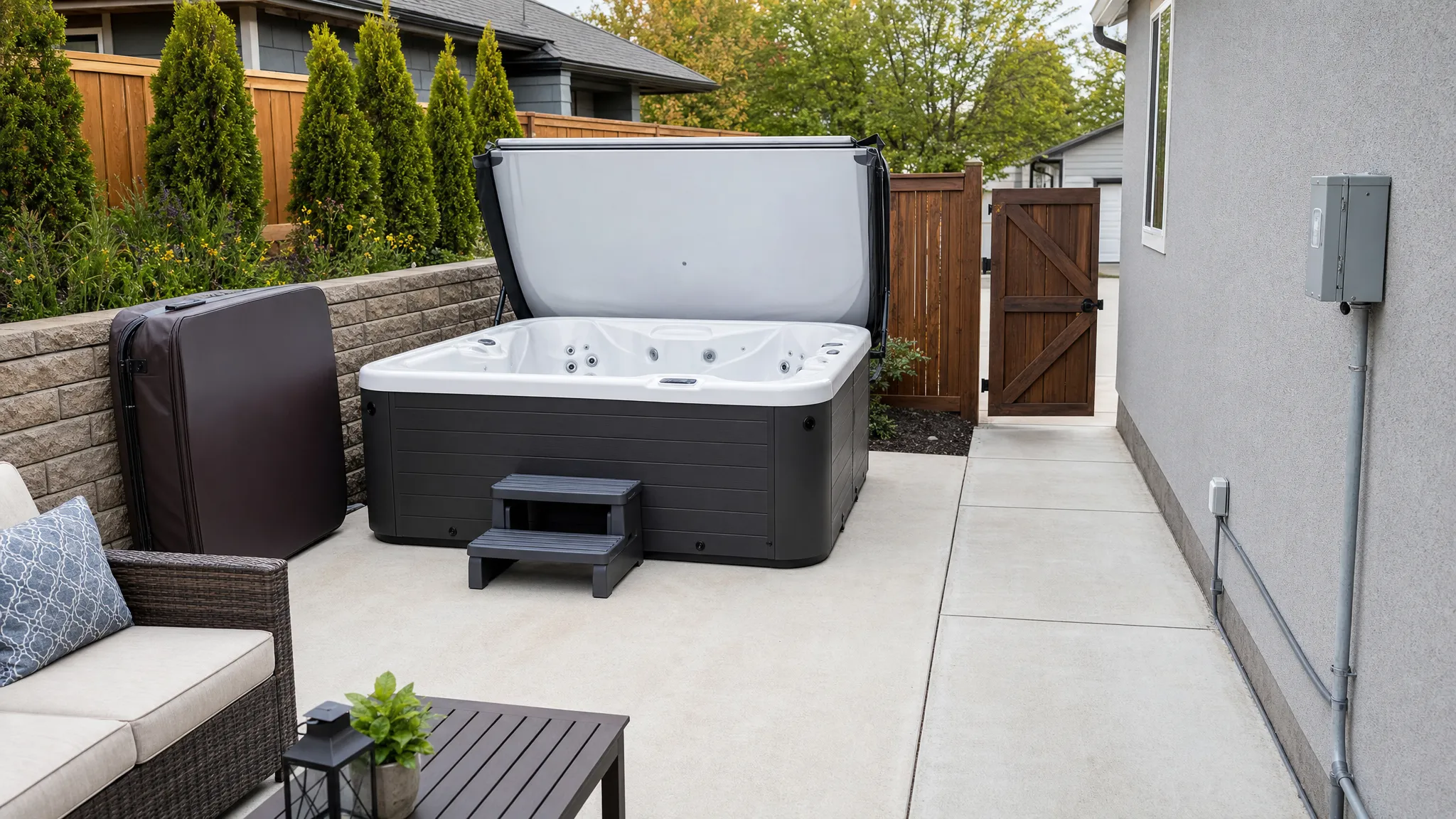
If your hot tub won’t heat, the cause is almost always one of five things: restricted water flow (dirty filter, low water, or a closed valve), a tripped high-limit or GFCI, a failed heating element, a bad flow/pressure switch, or a faulty thermostat or sensor. Work them in that order. The first three you can check yourself in about ten minutes for free; the rest run roughly $100–$450 to fix. We sold and serviced hot tubs for two years ($12M in sales, 2024–2025), and the single most common “dead heater” service call we ran turned out to be a clogged filter, not a broken part. Start cheap before you spend a dime.
Why won’t our hot tub heat? The quick diagnosis table
Here is the fast version. Match your symptom to the likely cause, then read the section below it for the fix and the cost.
| Symptom | Most likely cause | Typical fix cost |
|---|---|---|
| Pump runs, water moves, but stays cold | Dead heating element | $150–$400 installed |
| Weak or no water flow from jets | Dirty filter, low water, or air lock | $0–$30 |
| Error code FLO, FLC, or DRY | Flow/pressure switch or circulation | $100–$250 |
| Reads wrong temp / heater never kicks on | Thermostat or temp sensor | $100–$300 |
| Code OH or HL, then shutdown | High-limit trip (often flow-related) | $0–$120 |
| Panel dead or heater won’t respond | Tripped GFCI or failed control board | $0–$1,000 |
Start here: the 5-minute checks that cost nothing
Before you call a tech or order parts, rule out the free stuff. On the service calls we went on, more than half of “our hot tub won’t heat” complaints were solved in this list:
- Check the temperature setting. Sounds obvious, but a bumped button or a “summer mode”/economy schedule keeps the heater off. Set it to a real target (100–102°F) and wait.
- Look for lock or standby mode. Many panels have a child-lock or a “priming”/standby state that disables the heater. Check the manual for your model’s reset sequence.
- Clean or remove the filter. A clogged filter is the number-one flow killer. Pull it out entirely and run the tub for 30 minutes — if it starts heating, your filter (or a clog) was the culprit.
- Top up the water. Low water lets air into the pump and starves the heater of flow. Fill to the manufacturer’s line.
- Reset the GFCI breaker. A tripped ground-fault breaker cuts power to the heater circuit. Reset it once; if it trips again immediately, stop — that points to a wiring or element fault that needs a pro.
- Find the heater reset button. Some models have a manual high-limit reset near the heater housing. One press can bring a “dead” heater back to life.
If none of that works, you have a genuine component failure. Here are the four parts that fail, in the order we’d check them.
1. Is the heating element dead?
The element is a metal coil that the water passes over. It is the most common true failure, especially on tubs run with poorly balanced water — high calcium scales it over, low pH corrodes it. The tell is simple: the circulation pump runs and water moves through the jets, but the water never warms and you get no error code.
The good news is the element itself is cheap — a bare element runs about $30, and a complete Balboa-style heater assembly with the tube is roughly $90–$120 in parts. The cost is the labor and the swap. Expect $150–$400 installed by a tech, less if you’re comfortable shutting off power and doing it yourself. If your tub is out of warranty and over 10 years old, weigh this against the section at the bottom on replacing the whole unit.
2. Flow problems: the cause we saw most as a dealer
Heaters are designed not to fire unless water is moving past them — it’s a safety feature so the element never runs dry and melts. That safety check is handled by a flow switch (paddle-style) or a pressure switch. When flow drops, the switch opens the circuit and the heater shuts off, usually throwing a FLO, FLC, or DRY code.
Restricted flow comes from a dirty filter (again), a clogged impeller, a partially closed valve, or an air lock after a drain-and-refill. If you’ve cleared all of those and still get a flow code, the switch itself has failed. A flow or pressure switch part is $20–$50; replaced by a tech it runs $100–$250. This is a common and very fixable failure — don’t let anyone talk you into a new control board until the switch and the actual flow have been ruled out.
3. Thermostat or temperature sensor
If the panel shows a temperature that’s clearly wrong — reads 104°F while the water is lukewarm, or vice versa — the thermostat or temp sensor is feeding the board bad data, so the heater either never turns on or shuts off early. Compare the panel reading to a real thermometer in the water. A mismatch points here. Replacing a hot tub thermostat or sensor typically costs $100–$300 all in.
4. The control board (check this last)
The circuit board is the brain that tells the heater to fire. It does fail — from age, moisture, or a power surge — but it’s the last thing to suspect because it’s the most expensive and techs sometimes reach for it first. A replacement board is $200–$1,000 depending on brand, and parts-plus-labor on a control-system repair runs $300–$1,000+. Before you authorize that, insist the element, flow switch, and sensor have all been tested. On a budget plug-and-play tub, a $600 board repair often isn’t worth it.
Hot tub error codes that mean “no heat”
Your panel is trying to tell you exactly what’s wrong. The common no-heat codes (wording varies by brand — Balboa, Gecko, and others):
- FLO / FLC / FL — Flow problem. The heater can’t sense enough water movement. Check filter, water level, and the flow switch.
- DRY / DR / DRYING — The system thinks the heater is dry. Same root causes as a flow code.
- OH / HOT — Overheat. The water hit the safety ceiling (often 110°F). Usually a stuck circulation issue or a failing sensor; the heater locks out to protect itself.
- HL / HFL — High-limit trip. The high-limit switch cut the heater. Look for the manual reset button before replacing anything.
- SN / SNS / SENSOR — A temperature sensor fault. Points to sensor replacement.
A full code-by-code breakdown across brands is its own guide, but if your tub won’t heat and shows any of the above, the diagnosis tables here cover the cause.
What hot tub heater repairs actually cost
Putting the verified 2026 numbers in one place so you know whether a quote is fair:
| Repair | Part only | Installed (parts + labor) |
|---|---|---|
| Heating element | ~$30 | $150–$400 |
| Complete heater assembly | $90–$120 | $200–$450 |
| Flow / pressure switch | $20–$50 | $100–$250 |
| Thermostat / temp sensor | $30–$80 | $100–$300 |
| Control / circuit board | $200–$1,000 | $300–$1,000+ |
Sources: HomeGuide hot tub repair cost data (2026), Leslie’s, and Fixr. Your quote will vary with brand and region.
When it’s cheaper to replace the tub than fix it
Here’s the dealer math we’d give a friend: if your tub is under warranty, call the manufacturer first — don’t pay out of pocket for a covered part. If it’s out of warranty and the fix is a sub-$300 element, switch, or sensor, repair it. But if you’re staring at a $600–$1,000 control-board job on a tub that’s 10-plus years old, you’re putting good money into a unit near the end of its life. (For how long different tiers actually last, see our lifespan-by-brand breakdown.)
If replacement makes more sense, a reliable plug-and-play tub avoids most of these heating headaches because the systems are simpler. Our top-scored plug-and-play pick is the Lifesmart LS200 (Value Score 78/100) — see the Lifesmart review or check current pricing on Amazon. If you want a hard-wired 240V tub that heats faster and holds temperature in the cold, the Bullfrog A8L (75/100) is the dealer-grade pick. Before you buy anything, run your numbers through our running cost calculator so you know the real monthly cost of keeping it hot.
Frequently asked questions
Why is our hot tub running but not heating?
If the pump runs and water circulates but the water stays cold with no error code, the heating element has most likely failed. If you see a flow code (FLO/DRY), the cause is restricted water flow or a bad flow switch, not the element. Check the filter and water level first.
How much does it cost to fix a hot tub that won’t heat?
Most no-heat repairs run $100–$400: a heating element is $150–$400 installed, a flow or pressure switch is $100–$250, and a thermostat or sensor is $100–$300. A control-board repair is the expensive outlier at $300–$1,000+, which is why you should rule it out last.
Can we fix a hot tub heating element myself?
Yes, if you’re comfortable shutting off power at the breaker and working around plumbing. The part is inexpensive (~$30 for the element). The risk is electrical, so if the GFCI trips when you reset it, or you’re unsure, hire a pro — the labor is the bulk of the cost anyway.
What does FLO mean on our hot tub?
FLO (or FLC/FL) is a flow error: the system can’t detect enough water moving past the heater, so it shuts the heater off as a safety measure. The usual causes are a dirty filter, low water, an air lock after refilling, or a failed flow/pressure switch.
How long should a hot tub take to heat up?
A healthy tub heats roughly 3–6°F per hour, so a full cold fill can take 8–20 hours depending on size, voltage, and insulation. A 240V tub heats noticeably faster than a 120V plug-and-play. If yours has slowed dramatically, that’s an early sign of a scaling element or weakening flow.
Before you repair or replace, know the real cost
A heater fix is one number — the cost of running the tub for the next decade is the bigger one. Use our free tools to make the call with real figures, not guesses.
Hot Tub Running Cost Calculator →
10-Year Total Cost of Ownership Calculator →
Buying used and worried about the heater? Our 12-point used hot tub inspection checklist shows exactly how to test the heating system before you hand over cash. And if you’re shopping new, start with our scored best hot tubs of 2026.