Do You Need a Hot Tub Electrician for Installation?
If you searched for a hot tub electrician near me, you are probably at the point where the spa is picked out, the delivery date is close, or you just realized that “plug-and-play” and “hard-wired” are not the same thing.
Here is the short version: most 240V hot tubs need a licensed electrician, while some 120V plug-and-play hot tubs can use an existing outlet if that outlet meets the manufacturer’s requirements and local code. The tricky part is that the outlet, breaker, GFCI protection, distance from the tub, wiring condition, and permit rules all matter.
Because hot tubs combine water, people, outdoor wiring, and high electrical loads, this is not a good place to guess. A good electrician does more than “add a breaker.” They verify that your home can safely power the spa, install the correct protection, and help you avoid failed inspections, nuisance trips, warranty issues, and unsafe shortcuts.
Quick answer: when do you need a hot tub electrician?
Use this table as a starting point. Your owner’s manual and local code always come first.
| Hot tub setup | Do you need an electrician? | Why |
|---|---|---|
| 120V plug-and-play with an existing dedicated outdoor GFCI outlet | Maybe | No hardwiring may be required, but the outlet still needs to meet the tub’s amp, GFCI, location, and condition requirements. |
| 120V plug-and-play with no dedicated outlet nearby | Usually yes | Many plug-and-play tubs should not share a circuit with lights, garage outlets, refrigerators, or other loads. |
| Convertible 120V/240V tub used on 120V at first | Maybe | You may be able to start on 120V, but upgrading to 240V later requires an electrician. |
| 240V hard-wired hot tub | Yes | A dedicated circuit, GFCI protection, disconnect, correct wire sizing, grounding, and bonding are typically required. |
| Any install involving trenching, a subpanel, or a panel upgrade | Yes | These jobs involve code, permits, load calculations, burial depth, and inspection requirements. |
For buyers still deciding between voltage types, our 120V vs 240V hot tub guide explains the performance tradeoffs, installation cost ranges, and when a hard-wired spa is worth the extra setup.
Why hot tub electrical work is different from a normal outlet
A hot tub is not just another backyard appliance. It may run pumps, a heater, lights, controls, ozone or sanitation equipment, and sometimes auxiliary components in a wet outdoor environment. That combination creates a higher safety standard than plugging in a patio light or a small fountain.
In the United States, hot tub electrical installations are commonly governed by local code based on the National Electrical Code, especially rules related to pools, spas, and hot tubs. Local jurisdictions can add their own requirements, and inspectors may interpret details differently, so a licensed local electrician is usually the safest route.
The big items usually include GFCI protection, a dedicated circuit, correct wire and breaker sizing, an accessible disconnect, proper grounding and bonding, weather-rated materials, and safe routing of outdoor wiring. If the tub is hard-wired, there is also the question of whether your main electrical panel has enough capacity and physical breaker space.
That is why the phrase “hot tub electrician near me” matters. You do not just want any low-cost handyman. You want someone who understands spa loads, outdoor disconnect placement, GFCI troubleshooting, and local permit expectations.
120V plug-and-play hot tubs: when you may not need new wiring
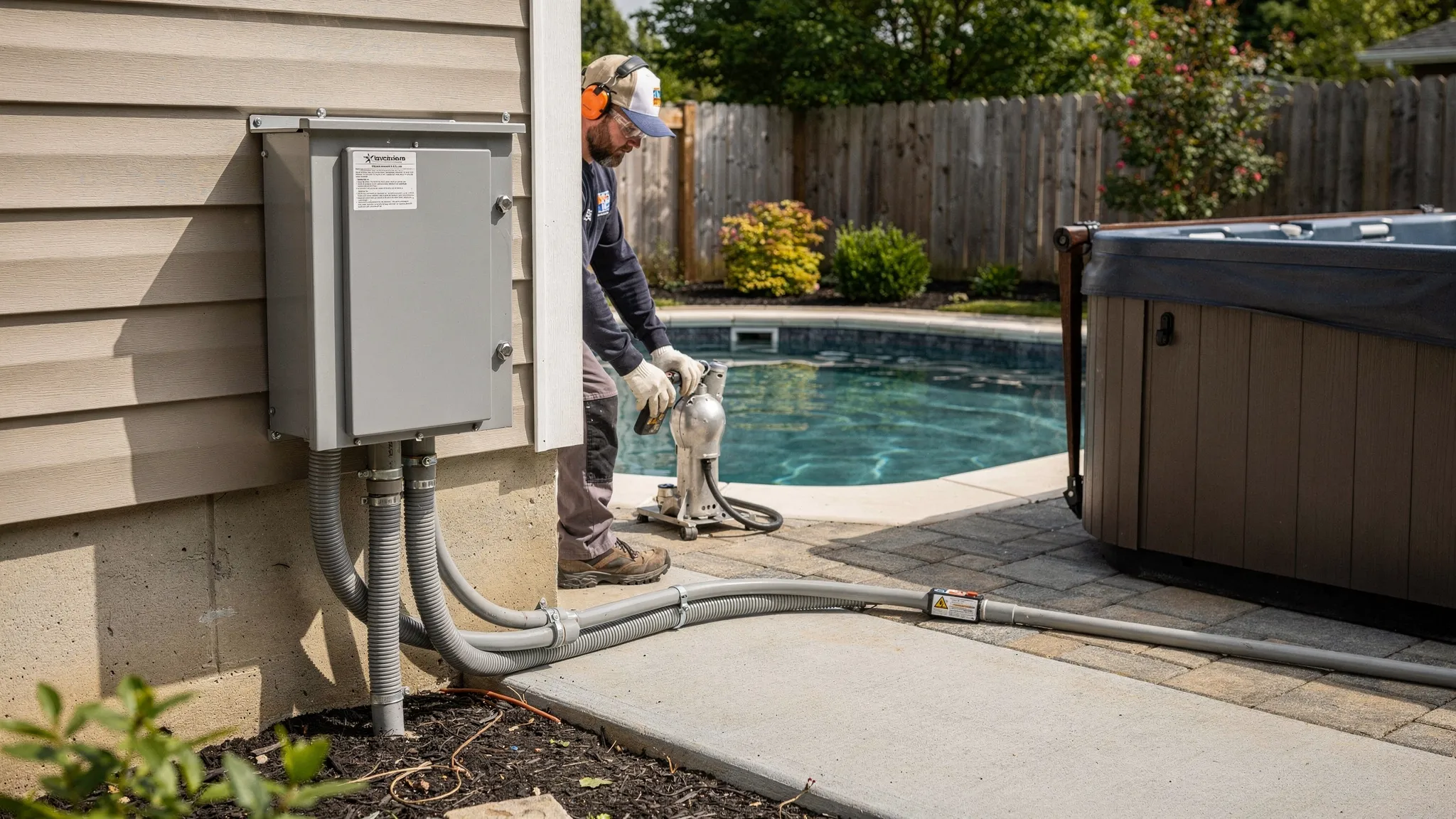
A true 120V plug-and-play hot tub is designed to plug into a standard household-voltage outlet, usually with GFCI protection. This is one reason plug-and-play models are popular with renters, first-time buyers, and shoppers trying to avoid the upfront cost of a 240V installation.
But “plug-and-play” does not mean “plug into any outlet you can find.” Many manufacturers require a dedicated outlet, meaning the hot tub is the only significant load on that circuit. Sharing a circuit with garage outlets, exterior lights, a freezer, power tools, or holiday decorations can cause tripping or unsafe overloads.
You should be especially cautious if the outlet is old, loose, ungrounded, not weather-protected, or located too close to the water. Extension cords are also a major red flag. Most hot tub manufacturers prohibit extension cords because they can overheat, create voltage drop, and defeat the safety assumptions built into the spa’s design.
If you already have a modern outdoor GFCI outlet in the right location on a dedicated circuit, you may not need a full electrical project. Still, paying for a quick electrician inspection can be worth it before delivery. A small pre-install correction is much cheaper than having a filled hot tub that trips constantly or cannot be used.
240V hot tubs: when a licensed electrician is non-negotiable
Most full-size performance hot tubs are 240V hard-wired models. Many use a dedicated 50-amp circuit, though some models call for different breaker sizes. The only number that matters is the one in the manufacturer’s installation manual and on the spa’s electrical data plate.
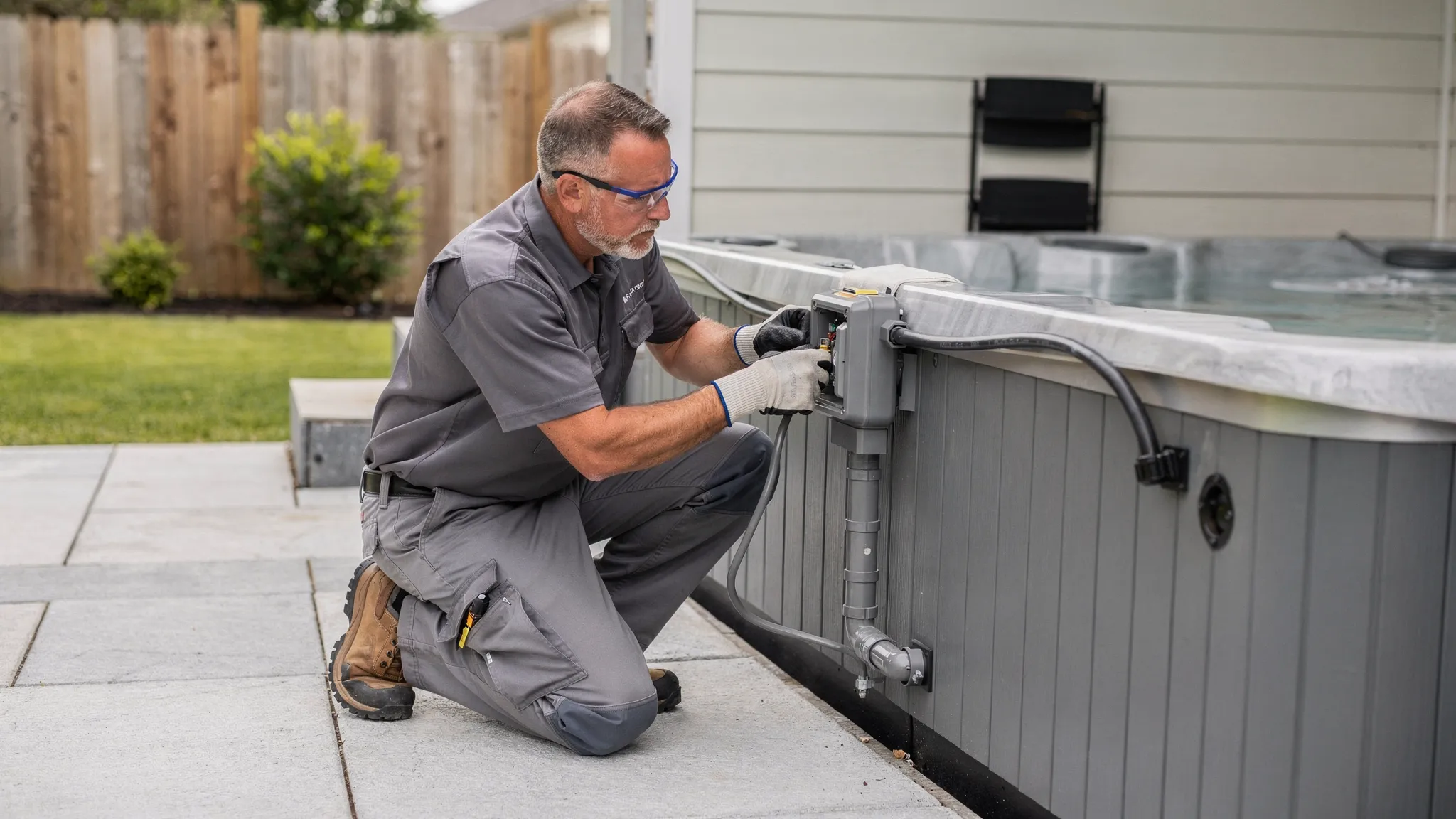
A 240V installation typically involves running a dedicated circuit from your electrical panel to an outdoor spa disconnect or spa panel, then wiring from the disconnect to the hot tub. GFCI protection is normally required. The electrician may also need to install conduit, route wiring through a crawlspace or exterior wall, trench underground to a patio, or coordinate with an inspector.
The performance benefit is real. A 240V spa can usually heat faster, recover temperature better in cold weather, and run heater and jet functions more effectively than many 120V models. But that performance comes with added setup cost and complexity.
Before you buy a 240V tub, confirm the electrical requirements and ask an electrician whether your home can support it without a panel upgrade. This is especially important for older homes, homes with full panels, detached garages, long backyard runs, or locations where the tub will sit far from the main service panel.
What a qualified hot tub electrician will check
A good electrician should not quote the job based only on “it is a 50-amp hot tub.” They should want the installation manual, the tub location, panel information, and the proposed wiring path.
At a minimum, expect them to evaluate the manufacturer’s electrical requirements, the available panel capacity, breaker compatibility, GFCI protection, disconnect placement, wire and conduit route, grounding and bonding requirements, permit rules, and any trenching needs.
They may also ask about the final spa orientation, because the equipment access panel needs to remain reachable for service. If the electrician wires the tub before the delivery crew places it correctly, you may end up with conduit or whip placement that conflicts with the cabinet access panel.
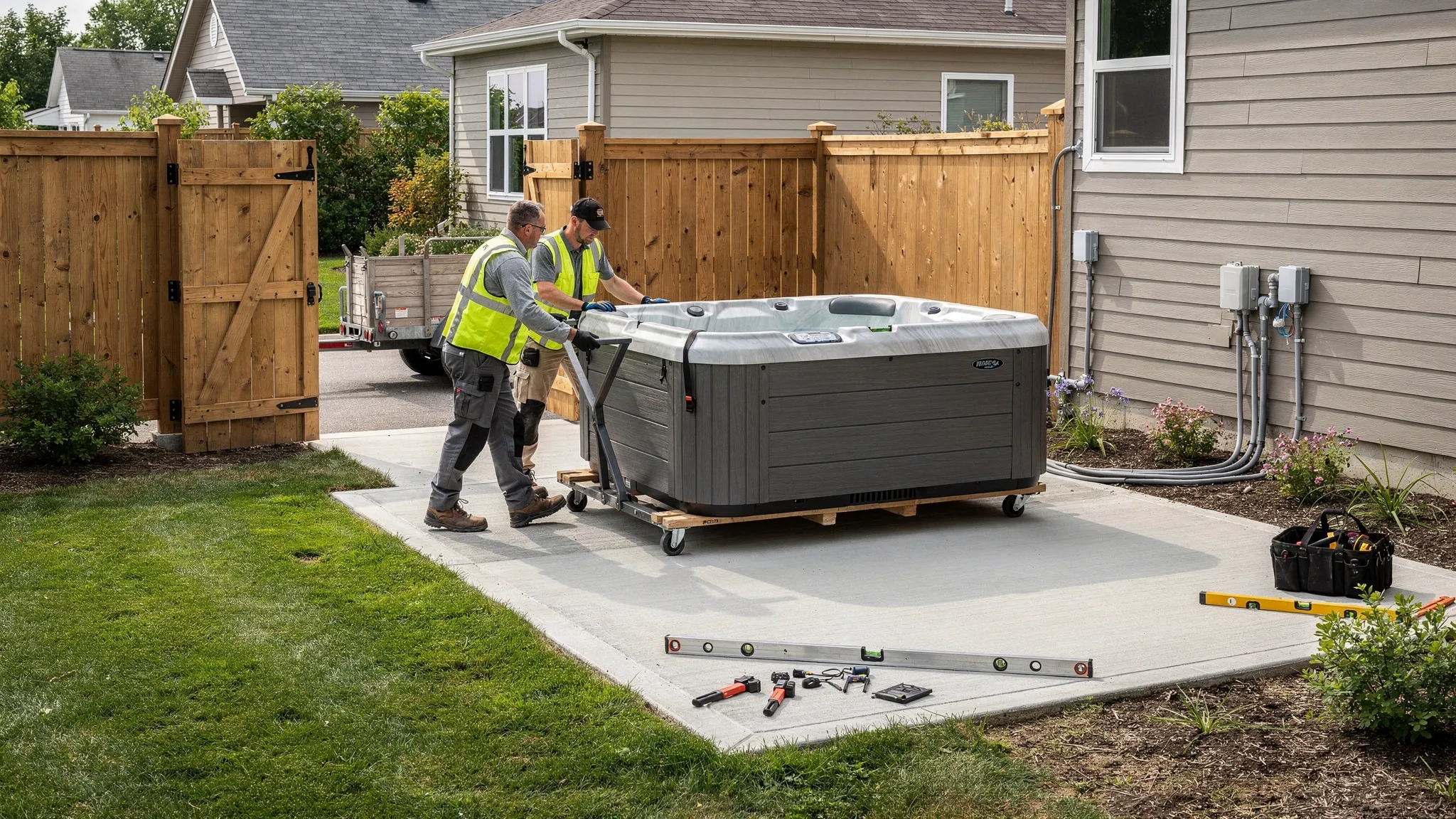
This is also where coordination matters. The hot tub dealer, delivery crew, concrete contractor, deck builder, and electrician all affect the final result. If the spa is going on a deck, you may also need structural confirmation that the deck can support the filled weight of the tub plus occupants.
How much does a hot tub electrician cost in 2026?
Hot tub electrical costs vary widely by location, distance from the panel, labor rates, permit requirements, panel condition, and whether trenching is needed. For a typical 240V hard-wired installation, many buyers should plan for roughly $400 to $2,000 or more, with complex projects exceeding that range.
Use this as a planning guide, not a quote.
| Electrical scope | Rough planning range | Common cost drivers |
|---|---|---|
| Existing 120V outlet inspection or minor correction | $100 to $300+ | Service call minimum, GFCI replacement, weather cover, labeling, outlet condition. |
| New dedicated 120V GFCI outlet | $250 to $700+ | Distance to panel, exterior wall access, breaker type, local labor rates. |
| Straightforward 240V hard-wired install near panel | $700 to $1,500+ | Breaker, spa panel or disconnect, conduit, wire, permit, short wiring run. |
| 240V install with long run or trenching | $1,500 to $3,500+ | Underground conduit, landscaping, concrete obstacles, distance, inspection. |
| Panel upgrade or major service work | $2,000 to $5,000+ | Existing service capacity, utility coordination, permit, panel condition. |
The cheapest quote is not always the best value. If one electrician is dramatically cheaper, check whether the quote includes the permit, GFCI protection, disconnect, trenching, final hookup, inspection coordination, and all materials.
Electrical setup is part of your real ownership cost, not a side detail. Before committing to a model, use our hot tub monthly running cost calculator to estimate ongoing energy costs, then combine that with your installation quotes to understand the true first-year cost.
How to choose a hot tub electrician near you
When you search for a local electrician, look for spa-specific experience. A licensed residential electrician may be excellent at panel work but still unfamiliar with the details that cause hot tub installs to fail inspection.
Ask whether they have installed hard-wired spas before, whether they pull permits when required, and whether they are familiar with local inspection standards for outdoor hot tubs. If the electrician immediately says “you do not need a permit” without asking your city or county, treat that as a warning sign.
Here are practical questions to ask before hiring:
| Question to ask | Why it matters |
|---|---|
| Are you licensed and insured for residential electrical work in my area? | Protects you if something goes wrong and helps ensure local code knowledge. |
| Have you wired hot tubs or swim spas before? | Spa installations have different requirements than ordinary outlets. |
| Will you review the manufacturer’s electrical manual before quoting? | Breaker size, wire type, and wiring method depend on the exact model. |
| Does your quote include GFCI protection and the outdoor disconnect? | Missing safety components can make a low quote misleading. |
| Will you handle permits and inspection if required? | Failed or skipped permits can create resale, insurance, and safety problems. |
| What happens if the GFCI trips after startup? | You want someone willing to troubleshoot the installation, not disappear after payment. |
It is also smart to get two or three quotes if the project is expensive. The goal is not to grind down the price. The goal is to spot missing scope, unrealistic assumptions, and major differences in how electricians plan to route the circuit.
Red flags that should stop the project
Some shortcuts are not worth the risk. Be careful if an installer or electrician suggests any of the following:
- Using an extension cord for a plug-and-play hot tub.
- Sharing a hot tub circuit with other household outlets or appliances.
- Skipping GFCI protection because “it trips too much.”
- Hardwiring a 240V spa without reading the manufacturer’s manual.
- Placing the disconnect wherever it is cheapest rather than where code requires it.
- Avoiding permits in an area where permits are required.
- Using a handyman for work that legally requires a licensed electrician.
GFCI trips can be annoying, but they are not a reason to remove protection. A trip may indicate moisture intrusion, a wiring error, a failing component, or an incompatibility that needs proper troubleshooting.
What to do before calling an electrician
You will get a better quote if you prepare a few details first. Start with the exact hot tub model, installation manual, voltage, amperage, and desired location. If you do not have the manual yet, ask the dealer or manufacturer for the pre-delivery guide.
Take clear photos of your main electrical panel, the proposed spa location, the route between them, and any obstacles such as concrete, fences, finished basements, retaining walls, or landscaping. Measure the approximate distance from the panel to the tub location.
If trenching may be involved, contact your local utility marking service before digging. In the United States, Call 811 helps coordinate utility marking so underground lines can be identified before excavation begins.
Finally, confirm whether the tub will sit on a concrete pad, pavers, a reinforced deck, or another base. The electrician may not be responsible for the pad, but electrical routing often depends on where the tub’s equipment bay and access panel will land.
Should you decide on the electrician before choosing the hot tub?
If you are choosing between a 120V model and a 240V model, yes, it is smart to talk to an electrician before you buy. A 240V hot tub that looks like a good deal can become much less attractive if your electrical panel is full, the run is long, or a panel upgrade is required.
On the other hand, avoiding 240V only because of installation cost can also be a mistake. In colder climates or for buyers who use jets heavily, a 240V spa may deliver better temperature recovery and a more satisfying ownership experience. The right answer depends on your climate, budget, usage pattern, and house wiring.
This is why Hot Tub Value Guide treats setup as part of value, not an afterthought. A lower sticker price does not always mean a better buy if the installation is expensive, the operating cost is high, or the spa’s performance does not match your needs.
If you are leaning toward a hard-wired spa, compare models in our best 240V hot tubs guide. If you are still early in the process, review our transparent scoring methodology to see how setup, energy use, durability, comfort, warranty, and other factors influence long-term value.
Frequently Asked Questions
Do all hot tubs need an electrician? No. Some 120V plug-and-play hot tubs can use an existing compatible outdoor GFCI outlet. However, 240V hard-wired hot tubs almost always require a licensed electrician, and even plug-and-play tubs benefit from an outlet inspection if you are unsure.
Can I plug a hot tub into a regular outlet? Only if the hot tub is designed for 120V plug-and-play use and the outlet meets the manufacturer’s requirements. Many tubs need a dedicated GFCI-protected circuit. Never assume a random patio or garage outlet is acceptable.
How much does it cost to wire a 240V hot tub? A typical 240V hot tub electrical installation often falls around $400 to $2,000 or more, depending on distance, materials, permits, and panel condition. Long runs, trenching, or panel upgrades can push the cost higher.
Can I use an extension cord for a plug-and-play hot tub? In most cases, no. Hot tub manufacturers commonly prohibit extension cords because they can overheat, cause voltage drop, and create safety risks. Use the manufacturer-approved cord and outlet setup only.
Do I need a permit for hot tub electrical work? Many cities and counties require permits for new 240V circuits, outdoor spa panels, trenching, or panel modifications. Permit rules are local, so ask your electrician and verify with your building department.
Should the electrician come before or after hot tub delivery? Ideally, talk to the electrician before purchase or delivery, especially for 240V models. Final hookup usually happens after the tub is placed, but planning should happen early so the disconnect, conduit, and access panel locations work together.
What should I send an electrician for an accurate quote? Send the model name, electrical manual, voltage and amperage requirements, photos of your main panel, photos of the spa location, approximate distance from panel to tub, and notes about trenching or obstacles.
Bottom line: search locally, but decide based on value and safety
If you are buying a 240V spa, the answer is simple: hire a licensed hot tub electrician near you and make sure the work is permitted and inspected where required. If you are buying a 120V plug-and-play model, you may not need new wiring, but you still need the right dedicated GFCI-protected setup.
Before you book the install, make sure the hot tub itself is worth the electrical investment. Compare voltage options, estimate operating costs, and review model-level tradeoffs using Hot Tub Value Guide’s independent buying resources, starting with the 120V vs 240V guide and running cost calculator.
Helpful next steps