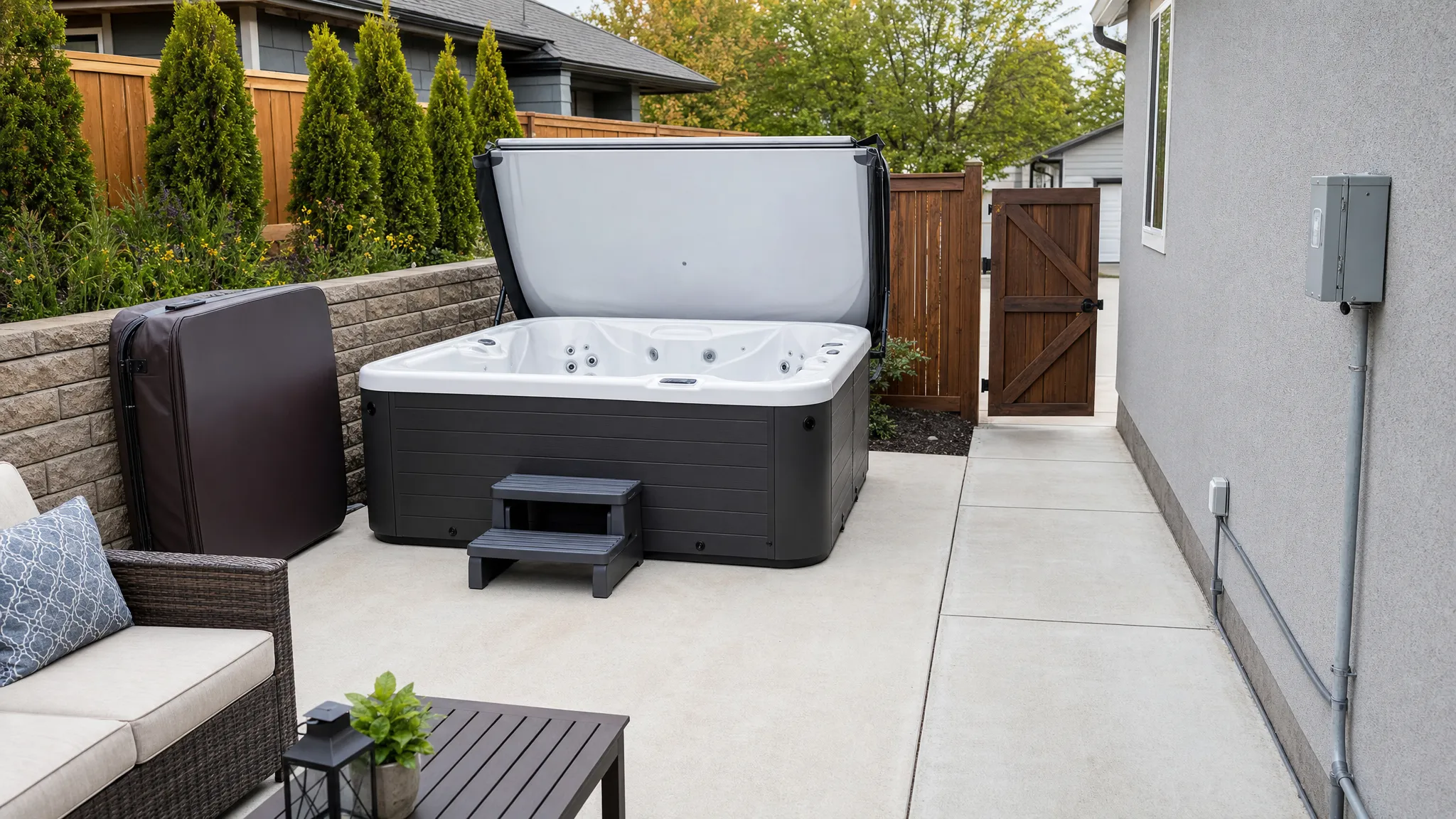
Direct answer: In 2026, most U.S. buyers should budget $3,000-$8,000 for a hard-shell plug-and-play hot tub, $9,000-$18,000 for a midrange 240V family spa, and $16,000-$30,000+ for a premium dealer-sold hot tub once delivery, electrical work, a base, accessories, and the first year of ownership are included. The cheapest inflatable tubs can start under $1,000, but they usually trade away insulation, durability, and winter performance.
The sticker price is only the starting point. Two hot tubs with similar seat counts can land thousands of dollars apart once you include the base, electrician, delivery route, cover quality, chemicals, filters, energy use, and warranty support. This guide breaks down realistic hot tub prices by setup so you can compare total ownership cost instead of chasing the lowest advertised number.
2026 hot tub prices by setup
The ranges below are broad because dealer pricing, regional labor rates, sales tax, access, climate, and brand tier all matter. Use them as planning numbers before you request quotes.
| Setup type | Typical tub price | Setup and installation range | Realistic first-year budget | Best fit | Skip if |
|---|---|---|---|---|---|
| Inflatable hot tub | $400-$1,500 | $100-$500 | $900-$2,800 | Renters, short-term use, mild weather testing | You want strong jets, cold-weather efficiency, or long lifespan |
| Entry hard-shell plug-and-play | $2,500-$5,000 | $500-$2,000 | $3,500-$7,500 | Budget buyers, small patios, simple soaking | You expect premium massage, fast heating, or heavy winter use |
| Better insulated plug-and-play | $5,000-$8,000 | $700-$2,500 | $6,500-$11,500 | Value shoppers who want easier setup and better durability | You need 240V performance or dealer-level service support |
| Convertible 120V/240V spa | $5,000-$9,500 | $700-$4,000 | $7,000-$14,000 | Buyers who may upgrade electrical later | You need maximum performance immediately and do not want a second setup cost |
| Midrange 240V family hot tub | $8,000-$16,000 | $2,000-$6,000 | $11,500-$23,000 | Families, cold climates, frequent use, stronger jets | Your budget cannot absorb electrical, base, and repair reserves |
| Premium dealer-sold 240V spa | $14,000-$25,000+ | $2,500-$7,000+ | $18,000-$32,000+ | Long-term owners prioritizing comfort, dealer support, and higher-end build | You only soak occasionally or are stretching financing to afford it |
These figures exclude unusual construction, major deck rebuilding, extensive trenching, landscaping changes, and panel upgrades. If your setup needs any of those, the project can move from “hot tub purchase” to “backyard renovation” very quickly.

Why advertised hot tub prices are often misleading
Hot tub listings often highlight seat count, jet count, or a sale price. Those numbers help, but they do not tell you what the tub will cost to own. A $4,500 plug-and-play model may be a good value if you already have a proper outlet, level pad, and mild climate. The same tub can feel underpowered if it sits outside through freezing winters and loses heat during long jet cycles.
Dealer-sold 240V spas have the opposite problem. The quote may include delivery, cover, steps, a starter kit, or dealer support, but it may not include electrical work, a concrete pad, permit costs, crane placement, sales tax, or trip charges for warranty service. Always compare written out-the-door quotes, not verbal “show special” prices.
The most useful way to evaluate hot tub prices is to separate the purchase into five buckets:
- Tub price, including the exact model, trim, cabinet, cover, and included accessories.
- Site preparation, such as a concrete pad, pavers, gravel base, or deck reinforcement.
- Electrical work, based on the manufacturer’s manual and local code.
- Delivery and placement, including stairs, tight gates, long carries, or crane needs.
- First-year ownership, including electricity, chemicals, filters, water, and small accessories.
If you are still deciding between categories, start with our broader guide on how to choose the best hot tub for your budget, backyard, and setup.
Setup cost breakdown: what buyers forget to budget
A hot tub needs a level, load-bearing base, safe electrical service, and enough access for delivery. Skipping any of those can lead to delays, warranty problems, or damage.
| Cost item | Typical 2026 range | What to verify before buying |
|---|---|---|
| Level gravel or spa pad base | $300-$1,500 | Confirm weight rating, drainage, and manufacturer base requirements |
| Concrete pad | $1,000-$4,000 | Thickness, reinforcement, slope, curing time, and access for installers |
| Deck reinforcement | $500-$5,000+ | Have a qualified contractor confirm live load and full filled-spa weight |
| Basic delivery or backyard placement | $0-$800 | Curbside vs placed, stairs, gates, slope, and packaging removal |
| Crane or specialty placement | $500-$2,000+ | Needed for fences, steep lots, rooftops, or tight side yards |
| 120V outlet or dedicated circuit work | $250-$900 | Manual requirements, GFCI protection, outlet condition, and dedicated circuit needs |
| 240V hardwired electrical | $1,000-$3,500 | Circuit size, disconnect, wire run, panel capacity, permits, and inspection |
| Panel upgrade or long trenching | $2,000-$6,000+ | Older homes, detached pads, long runs, or insufficient electrical capacity |
| Accessories not included | $200-$1,200 | Steps, cover lifter, filters, test kit, chemicals, hose filter, and spa vacuum |
For electrical work, do not guess. Many 240V hot tubs require a dedicated 50A or 60A circuit, but the exact requirement depends on the manufacturer and model. Plug-and-play tubs are simpler, but they still need a proper GFCI-protected outlet and often should not share a circuit with other loads. Avoid extension cords unless the manufacturer explicitly allows them, which many do not.
Water and electricity are not a DIY experiment. The Electrical Safety Foundation International explains the role of GFCI protection, and your hot tub manual plus local code should guide the final installation. Get a licensed electrician’s quote before you place a nonrefundable deposit.
Plug-and-play hot tub prices: $2,500-$8,000 for most hard-shell models
Plug-and-play hot tubs are usually the lowest-cost hard-shell option because they run on 120V power and do not require a full 240V hardwired installation. In 2026, most respectable hard-shell plug-and-play models fall between $2,500 and $8,000, depending on size, insulation, cabinet quality, pump performance, warranty, and retailer.
The appeal is obvious: lower upfront cost, easier placement, and fewer installation steps. For small households, a compact 2-person or 4-person plug-and-play spa can be the best value if you want warm soaking more than aggressive jet power. See our shortlist of best plug-and-play hot tubs if you are comparing easy-setup models.
The tradeoff is performance. Many 120V tubs cannot run the heater at full power while the jets are on high. In mild weather, that may not matter. In cold weather, it can mean temperature loss during longer soaks. Some lower-cost models also use thinner covers, less insulation, smaller pumps, and shorter warranties.
A realistic first-year plug-and-play budget often looks like this:
| Example plug-and-play budget | Estimated cost |
|---|---|
| Tub purchase | $3,500-$6,500 |
| Base or pad | $500-$1,500 |
| Electrical check or outlet work | $0-$900 |
| Delivery or placement | $0-$600 |
| Accessories and water-care starter items | $250-$700 |
| First-year electricity and maintenance | $600-$1,500 |
| Estimated first-year total | $4,850-$11,700 |
If your hard ceiling is $5,000 for the tub itself, read our guide to the best hot tubs under $5,000. Just remember that “under $5,000” rarely means “under $5,000 all in.”
Convertible hot tub prices: flexible, but not always cheaper
Convertible hot tubs can start on 120V power and later be converted to 240V, assuming the model supports it and the work is done correctly. These usually cost $5,000-$9,500 for the tub, with total first-year costs varying widely based on whether you install 240V immediately or later.
This setup makes sense if you want to spread out costs, test the tub in 120V mode, or buy a model that fits your patio now but may need stronger performance later. It can also be a good compromise for first-time buyers who are not sure how often they will use the spa.
The downside is paying twice for planning if you are not careful. If you know you live in a cold climate, use the tub frequently, or care about stronger pump and heater performance, it may be cheaper to install 240V from the start. Our 120V vs 240V hot tub guide explains the performance differences in more detail.
240V family hot tub prices: $8,000-$16,000 before installation
A midrange 240V family spa is where many long-term buyers land. These tubs usually offer more heater capacity, stronger pump options, better cold-weather usability, and more traditional acrylic construction than entry plug-and-play spas. In 2026, expect many family-sized 240V hot tubs to list around $8,000-$16,000 before electrical work and site prep.
The all-in budget is much higher because 240V tubs normally need hardwired electrical work, a dedicated circuit, a disconnect, and professional installation. Many family spas also weigh several thousand pounds when filled, so the base matters. A small patio slab might be fine, or it might not be. You need before delivery day.
A typical 240V family setup might look like this:
| Example 240V family budget | Estimated cost |
|---|---|
| Tub purchase | $9,000-$16,000 |
| Concrete pad or equivalent base | $1,000-$4,000 |
| Licensed electrical work | $1,000-$3,500 |
| Delivery, placement, or site access extras | $0-$1,500 |
| Accessories not included | $300-$1,000 |
| First-year electricity and maintenance | $900-$2,200 |
| Estimated first-year total | $12,200-$28,200 |
This category is usually worth considering if you have a family, use the spa several times per week, live somewhere cold, or want the heater and jets to perform better together. For ranked examples, compare our best 240V hot tubs of 2026.
Premium dealer hot tub prices: $14,000-$25,000+ before extras
Premium dealer spas often cost $14,000-$25,000+ before installation variables. Some large luxury models, special trims, stereo packages, salt systems, advanced controls, or high-end cabinet options can push beyond that. The premium is not just about more jets. It often reflects dealer support, brand reputation, proprietary seating systems, higher-end materials, better insulation packages, and longer or more comprehensive warranties.
That does not mean premium always equals best value. A premium spa can be a smart buy if you plan to own it for many years, have reliable dealer service, and use it frequently. It can be a poor buy if the monthly payment hides a price you cannot comfortably afford, the dealer will not provide warranty terms in writing, or the model’s features do not match how you actually soak.
Before buying a premium spa, get a written quote showing the exact model, year, shell and cabinet color, included cover, steps, cover lifter, delivery, placement, startup chemicals, taxes, financing terms, warranty start date, labor coverage, and any trip fees. If a dealer will not put the full offer in writing, slow down.
Monthly ownership costs after purchase
Hot tub prices do not stop after delivery. A normal owner budget includes electricity, chemicals, filters, water, and a reserve for wear items. For most hard-shell spas, a practical monthly range is $50-$200, with cold climates, poor covers, high energy rates, large tubs, and frequent use pushing costs higher.
| Monthly cost category | Typical range | Notes |
|---|---|---|
| Electricity | $25-$150+ | Depends on climate, insulation, cover quality, usage, and local $/kWh |
| Chemicals and test supplies | $15-$50 | More if water balance is difficult or the tub is heavily used |
| Filters | $5-$20 | Monthly equivalent if replaced several times per year |
| Water and refill costs | $3-$20 | Usually modest, but varies by local rates and refill frequency |
| Cover and repair reserve | $15-$75 | Helps budget for cover replacement, pillows, sensors, pumps, and service calls |
| Practical monthly total | $50-$200+ | Financing, if used, is separate |
Electricity is the hardest number to estimate without your local rate. The U.S. Energy Information Administration tracks how residential electricity prices vary by location, but your own utility bill is the best input. For a better estimate, use our Hot Tub Monthly Running Cost Calculator and enter your local electricity rate, climate, and tub type.
A well-insulated 240V spa may cost less to run than a poorly insulated bargain tub in the same climate. Voltage alone does not determine efficiency. Heat loss does. Cover quality, cabinet insulation, water temperature, wind exposure, and how long the cover stays open matter more than many buyers expect.
Maintenance costs: plan for more than chemicals
First-time buyers often budget for chlorine or bromine and forget the rest. You will also need test strips or a liquid test kit, replacement filters, cleaning tools, occasional plumbing cleaner, water clarifier or defoamer if needed, and time for regular balancing.
A reasonable starter budget is $150-$400 for water-care supplies and small tools. After that, many owners spend $25-$70 per month on maintenance-related items, depending on usage, water quality, and whether they pay for professional service.
You should also expect periodic drains and refills. Many residential hot tubs are drained every 3 to 4 months, although the right interval depends on usage, water chemistry, and manufacturer guidance. If you are new to spa care, our hot tub maintenance for beginners guide walks through the first 90 days.
Maintenance is not just about water looking clear. Poor water balance can shorten equipment life, damage covers, irritate skin, and create warranty disputes. If you do not want to test and adjust water regularly, a hot tub may not be the right purchase.
Warranty and service: the hidden price difference
Two hot tubs with the same purchase price can have very different ownership risk. One may come from a local dealer with in-house service. Another may be shipped by a national retailer where warranty support involves calls, parts shipments, or finding your own technician.
Read the warranty before purchase, not after delivery. Look for separate coverage terms for shell structure, shell surface, plumbing, equipment, cabinet, controls, cover, labor, and trip charges. Also confirm when the warranty starts. Some warranties begin on purchase date, others may reference delivery or registration.
Common warranty questions to ask include:
| Warranty question | Why it matters |
|---|---|
| Is labor included, and for how long? | Parts coverage is less valuable if service labor is expensive |
| Are trip charges covered? | Rural or distant buyers may pay per visit |
| Who performs warranty service? | Dealer service, brand network, or owner-arranged repair are different experiences |
| What voids coverage? | Improper electrical work, bad water chemistry, poor base support, or unapproved accessories can matter |
| Is the cover covered separately? | Covers are wear items and often have shorter coverage |
This is one reason Hot Tub Value Guide uses a broader review process instead of ranking by price alone. Our public review methodology weighs setup, energy, durability, comfort, maintenance, warranty, and value signals because cheap ownership and low sticker price are not the same thing.
When to skip each hot tub price tier
The right price tier depends on how often you will use the tub, where it will sit, and how much ownership work you are willing to take on.
Skip inflatable hot tubs if you want winter performance, firm seating, strong jets, or a long service life. They can make sense for temporary use, but they are rarely the best long-term value. We explain our reasoning in why we do not review inflatable hot tubs.
Skip the cheapest plug-and-play models if you live in a freezing climate, want long evening soaks with jets on high, or expect a spa to feel like a premium hydrotherapy tub. They are best for simple soaking and budget-conscious ownership.
Skip 240V family tubs if you have not priced the electrical work, do not have a suitable base, or cannot leave enough service access around the cabinet. A good 240V spa can be worth it, but the wrong backyard setup can make it expensive.
Skip premium dealer spas if the monthly payment is the only way the price feels affordable, if the dealer will not itemize the quote, or if you only expect occasional use. A premium tub used twice a month is usually harder to justify than a simpler model used several times a week.
Skip buying any hot tub right now if you cannot budget for maintenance, if your landlord or HOA has not approved it, if your deck capacity is unknown, or if the electrical quote reveals a major panel upgrade you are not prepared to fund.
How to compare hot tub quotes without overpaying
The best way to compare hot tub prices is to make every seller quote the same cost categories. Ask for an itemized, written quote that includes the exact model and year, tub price, freight, delivery type, placement, accessories, taxes, financing terms, warranty terms, and what is excluded.
Then get separate numbers for base prep and electrical work. A dealer may estimate these, but the contractor or electrician doing the work should be the one confirming the actual cost. For 240V models, send the manual or electrical spec sheet to the electrician before the quote.
Finally, compare the total over 5 to 10 years, not just the cash price today. A $2,000 discount disappears quickly if the tub has poor insulation, a weak cover, limited service access, or a warranty that leaves you paying for labor. If you want a model-by-model way to think through value, start with our best hot tub brands for value, support, and durability.
Frequently Asked Questions
How much does a hot tub cost in 2026? Most hard-shell hot tubs cost $2,500-$25,000+ before installation. A realistic first-year budget is often $3,500-$11,500 for plug-and-play models, $11,500-$23,000 for midrange 240V family spas, and $18,000-$32,000+ for premium dealer models.
What is the cheapest hot tub setup? The cheapest setup is usually an inflatable hot tub, often under $1,500 before accessories. For a longer-lasting hard-shell option, entry plug-and-play tubs typically start around $2,500-$5,000, but you still need a proper base, safe electrical setup, and maintenance supplies.
How much does electrical work cost for a hot tub? Basic 120V outlet or dedicated circuit work may cost $250-$900, while many 240V hardwired installations cost $1,000-$3,500. Long wire runs, trenching, permits, or panel upgrades can add thousands. Always confirm requirements with the manual and a licensed electrician.
Are 240V hot tubs more expensive to run than 120V hot tubs? Not automatically. A 240V tub may use more power while heating, but it can heat more effectively and may perform better in cold weather. Actual energy cost depends more on insulation, cover quality, climate, water temperature, usage, and electricity rates.
How much should I budget per month after buying a hot tub? Many owners should budget $50-$200+ per month for electricity, chemicals, filters, water, and a repair or cover reserve. Financing, if used, is separate. Cold climates, large tubs, weak covers, and high utility rates can push costs higher.
Do hot tub prices usually include delivery and accessories? Sometimes. Dealer quotes may include local delivery, cover, steps, or starter chemicals, but not always. Online retailers may include curbside freight but charge more for placement or leave backyard movement to the buyer. Get every included item in writing.
Is a premium hot tub worth the higher price? It can be if you use it often, plan to keep it for many years, have strong dealer support, and value comfort, build quality, and warranty coverage. It may not be worth it if you only soak occasionally or if the purchase depends on stretching financing.
Next step: price the setup, not just the spa
Before you choose a model, write down your all-in budget for the tub, base, electrical work, delivery, accessories, and first-year ownership. Then compare models within that real budget instead of starting with a sale tag.
If you are still narrowing the category, use the 120V vs 240V hot tub guide to choose your power setup, then estimate ownership with the running cost calculator. The best deal is not the lowest price. It is the hot tub you can install safely, maintain consistently, and afford to run for years.